
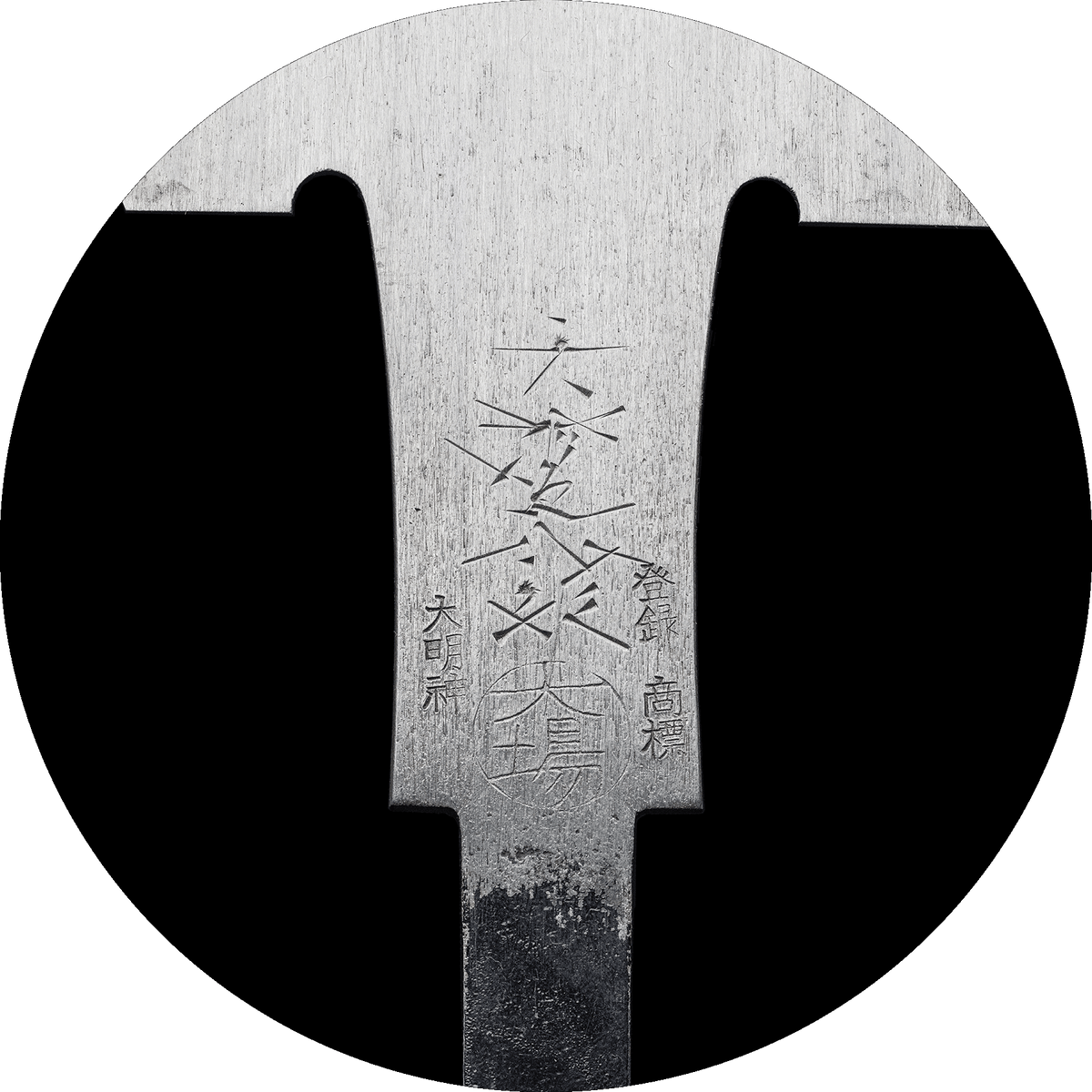
1: Mark of Nakaya Kyusaku(仲谷久作). Nakaya Kyusaku (仲谷久作) was a master saw blacksmith based in Tokyo whose lineage active from the late Edo period to the early Showa period. This particular saw has been authenticated by Mr. Noboru Tsuchida as an original, authentic work crafted by Nakaya Kyusaku XVI
(the 16th generation) during the Meiji period. A defining feature of the Nakaya Kyusaku lineage is their unique mark (mei), known as "Sasaba-mei" (笹葉銘), which artistically resembles scattered bamboo leaves.
Within this lineage, Nakaya Kyusaku XV(the 15th generation) remains the most legendary figure. Active from the late Edo to the mid-Meiji period, he reportedly unlocked the secret technique of oil-quenching simply by catching the scent of tempura wafting from the workshop of Nakaya Heijiro(中屋平治郎), a revered Tokyo master saw-smith. The 15th generation's reputation was so formidable that even Kuroda Kiyotaka, the Prime Minister at the time, famously traveled to his workshop in a horse-drawn carriage just to order a single custom saw.
The 16th generation succeeded the lineage, operating from the Meiji period into the early Showa period. According to historical insights provided by Mr. Tsuchida, some saws bearing the 16th generation's mark were not forged by his own hand, but were instead commissioned to his disciples. Despite these differences in production, single-edged rip saws crafted by both the 15th and 16th generations share a definitive, identical trait: the concave curve along the back (spine) of the blade is exceptionally shallow, making it appear almost perfectly straight.

2: Mark of Nakaya Takijiro Ⅳ(中屋瀧次郎). This saw features the signature (mei) "Bushu-ju Nakaya Takijiro Masayoshi-saku" (武州住中屋瀧次郎正義作), where "Bushu-ju" signifies "residing in Bushu" (the ancient
Musashi Province). This particular piece has been authenticated by the 5th generation Nakaya Takijiro as an original work crafted by the 4th generation.
The lineage began with Nakaya Takijiro I, who was born in Kawagoe, Saitama Prefecture, in 1825 under his birth name, Toda Takijiro(户田瀧次郎). He began his training under Futamiya Tetsugoro(二見屋鉄五郎), and a few years later, pursued advanced studies under Nakaya Jingoro(中屋甚五郎) in Konosu, Saitama Prefecture. Earning his master's deep trust, he married Jingoro's daughter and was adopted into the family, changing his surname to Ito(伊藤瀧次郎). For various reasons, he and his wife later left the master's household, and in 1852, he returned to Kawagoe to establish the independent "Nakaya Takijiro" blacksmith workshop.
Nakaya Takijiro II, born Ito Gennosuke(伊藤源之助), was the eldest son of the founder. After learning the trade at his father’s workshop, he sought to expand his horizons by studying under Tokyo’s renowned master Nakaya Kyusaku(中屋久作), as well as at Futamiya Okigoro's(二見屋冲五郎) workshop in Chofu. In the 13th year of the Meiji period (1880), he traveled to the Aizu region—then a premier stronghold for blacksmithing technology—to undergo rigorous training. From there, he brought back the cutting-edge technique of oil-quenching saw blades to Kawagoe, which at the time was still relying on primitive clay-water (mortar) quenching methods.
The eldest son of the second generation, Ito Kometaro(伊藤米太郎), succeeded the lineage as Nakaya Takijiro III. Born in the 15th year of the Meiji period (1882), he followed his father’s path by training under the master Nakaya Kyusaku(中屋久作) in Tokyo, and further refined his craft under Nakaya Sakujiro(中屋作次郎) in Utsunomiya. The 3rd generation nurtured numerous disciples throughout his career, but unfortunately succumbed to illness in the 10th year of the Showa period (1935) at the age of 54.
Because the 3rd generation had no sons, the family business was passed down to Ito Hanshichi(伊藤半七), the eldest son of his younger brother, Ito Jirokichi(伊藤次郎吉). Born in the 2nd year of the Taisho period (1913), Hanshichi lost his father at a young age and was adopted by his uncle, the 3rd generation Takijiro. He began apprenticing under his uncle in the 2nd year of the Showa period (1927). When the 3rd generation passed away in 1935, the workshop's finances were in a precarious state, kept alive solely by the grit of Hanshichi and a senior fellow apprentice. Fortunately, they managed to weather the crisis. Following the outbreak of World War II, Nakaya Takijiro IV was conscripted into the military. Having fortunately survived the war, he returned to his workshop in Kawagoe and began forging saws under the signature "Nakaya Takijiro Masayoshi/中屋瀧次郎正義."
According to insights shared by the 5th generation Takijiro, there is a fascinating secret hidden within the artisan's signature: if the character "Masa" (正) in "Masayoshi" (正義) is engraved with its full, formal block strokes rather than the abbreviated or cursive style shown in the photo, it serves as a definitive indicator that the saw was meticulously crafted using traditional, high-grade Tamahagane.
 3: Mark of Nakaya Takijiro Ⅴ(第五代中屋瀧次郎). This saw features the signature (mei) "Bushu-ju Nakaya Takijiro Masayoshi-saku" (武州住中屋瀧次郎正義作), where "Bushu-ju" signifies "residing in Bushu" (the ancient Musashi Province). Born in Ibaraki Prefecture in the 28th year of the Showa period (1953), the fifth-generation master's birth name is Ito Mamoru(伊藤守). After graduating from high school, he enlisted in the Japan Self-Defense Forces. Following several years of military service, he returned to civilian life, and in the 52nd year of the Showa period (1977), he crossed paths with Nakaya Takijiro IV, under whom he began his formal apprenticeship.
During his second year of learning the saw-making, he fell in love with his master's daughter, and the two were wed. By marrying into the family as an adopted son-in-law (yoshi), he fully inherited all the knowledge, secret techniques, and craftsmanship of Nakaya Takijiro IV.
Today, he single-handedly keeps the fires burning at this historic blacksmith workshop, preserving a heritage that spans more than a century. Notably, his workshop stands as the only remaining saw-forging blacksmith shop operating in the entire vicinity of Tokyo.

4: Mark of Nakaya Nabesaku Ⅱ(第二代中屋辺作). On this piece, the small characters inscribed to the right of the mark read "Nidaime/二代目" (Second Generation). Like the Nakaya Takijiro workshop, this blacksmith shop was also located in Kawagoe, Saitama Prefecture. The second-generation master’s birth name was Takahashi Isetaro(高橋伊勢太郎). Born in the 25th year of the Meiji period (1892), he was the eldest son of Nakaya Nabesaku I.
The lineage’s founder, Nakaya Nabesaku I, was born in 1864 to a family that was also deep-rooted in Kawagoe's saw-making tradition; his biological father was named Nagahari Kakichi(長張嘉吉). He was later adopted into the nearby Takahashi family, taking the name Takahashi Nabetaro(高橋鍋太郎). As he grew older, he apprenticed at the workshop of Futamiya Kumajiro I(初代二見屋熊次郎) to learn the saw-making (both Nakaya Takijiro I and Futamiya Kumajiro I were disciples of the master Futamiya Tetsugoro). After completing his studies, he spent years honing his craft across various blacksmith shops in the Kanto region. In the 22nd year of the Meiji period (1889), at the age of 26, he returned to Kawagoe to establish his own workshop, forging saws under two homophonous signatures: "Nakaya Nabesaku" (中屋辺作) and "Nakaya Nabesaku" (中屋锅作). While his carpentry and lumbering saws were highly acclaimed, he tragically passed away in the 43rd year of the Meiji period (1910) at the young age of 47.
At the time of his father's sudden passing, Takahashi Isetaro was only 18 years old and had apprenticed for a mere five years. Determined to preserve his father's legacy, he spent the next eight years traveling, working, and studying at no fewer than five saw-blacksmith shops throughout the Kanto region. At the age of 25, he returned to Kawagoe to rekindle the forge, officially reviving his late father's workshop and the "Nakaya Nabesaku" lineage.
By the early Showa period, as he was approaching his 40s, Nakaya Nabesaku II had risen to become a nation-renowned master saw blacksmith. Although production was temporarily halted by the outbreak of World War II, he rapidly resumed operations post-war, with the subsequent decade marking the absolute pinnacle of his production output. He passed away in June of the 57th year of the Showa period (1982) without a successor, bringing an end to the lineage. Today, in honor of his craftsmanship, his historic blacksmith workshop has been meticulously preserved and remains on display inside the Kawagoe City Museum.

5: Mark of Nakaya Nabesaku (中屋辺作). At present, it remains unclear whether this mark is attributed to the first or the second generation.

6: Mark of Nakaya Kitaro (中屋喜太郎). This piece features the signature (mei) "Bushu-ju Nakaya Kitaro Saku" (武州住中屋喜太郎作), where "Bushu-ju" signifies "residing in Bushu" (the ancient Musashi Province).
While the blacksmith's birth name is unknown, it is known that he was a saw blacksmith based in Kawagoe or elsewhere in Saitama Prefecture. According to information provided by Mr. Tsuchida, he was active during the early Showa period, and his making skills were very good.

.%C2%A0Nakaya%20Kyusaku%20(%E4%BB%B2%E8%B0%B7%E4%B9%85%E4%BD%9C)%20was%20a%20master%20saw%20blacksmith%20based%20in%20Tokyo%20whose%20lineage%20active%20from%20the%20late%20Edo%20period%20to%20the%20early%20Showa%20period.%20This%20particular%20saw%20has%20b...)