
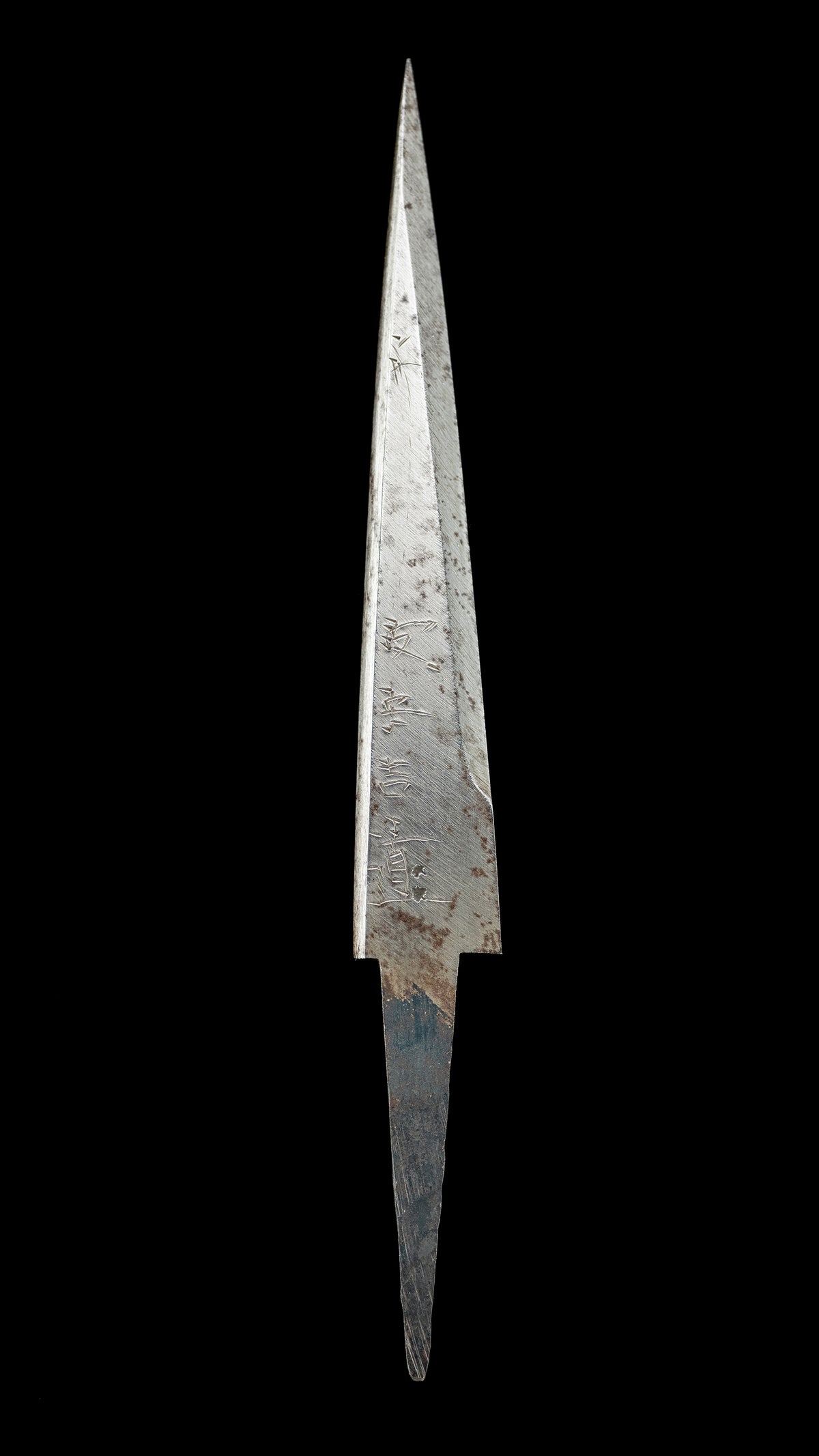

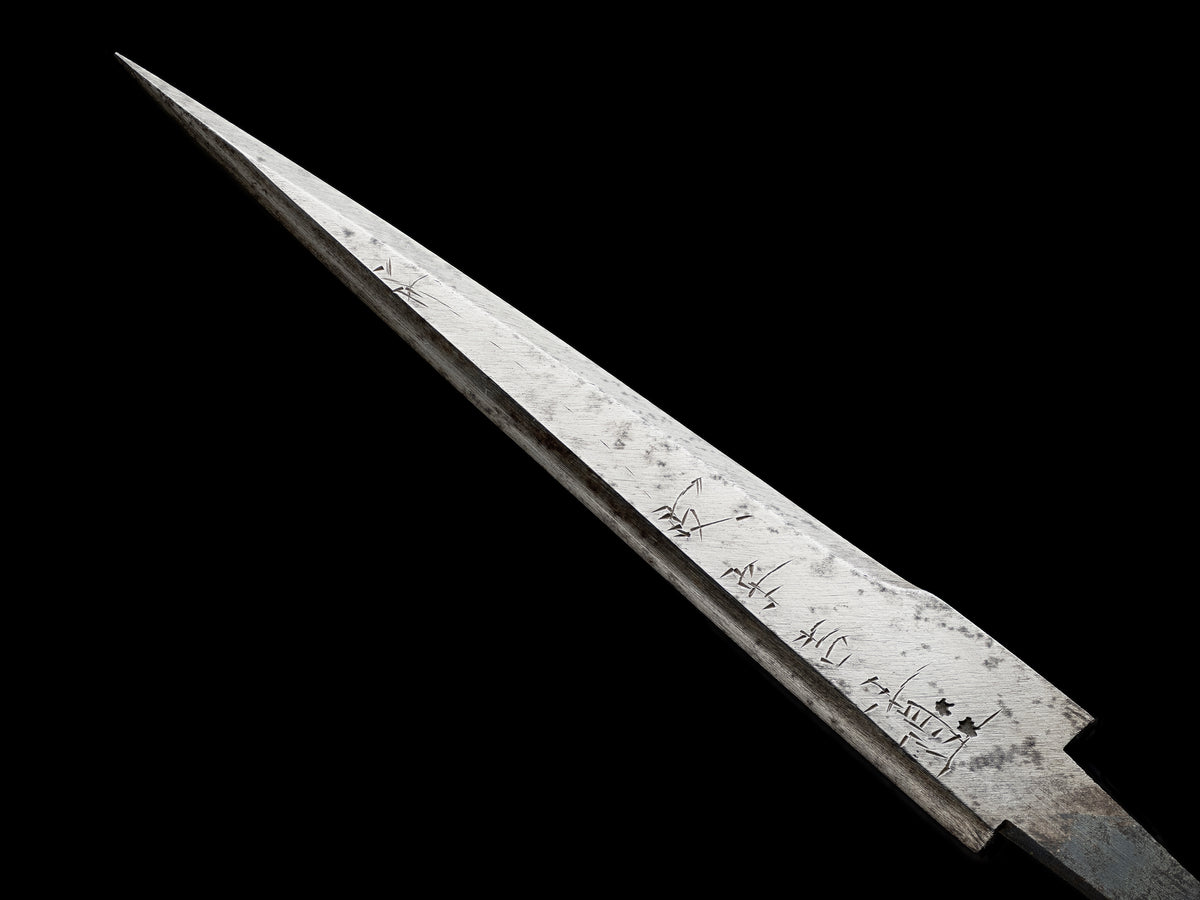
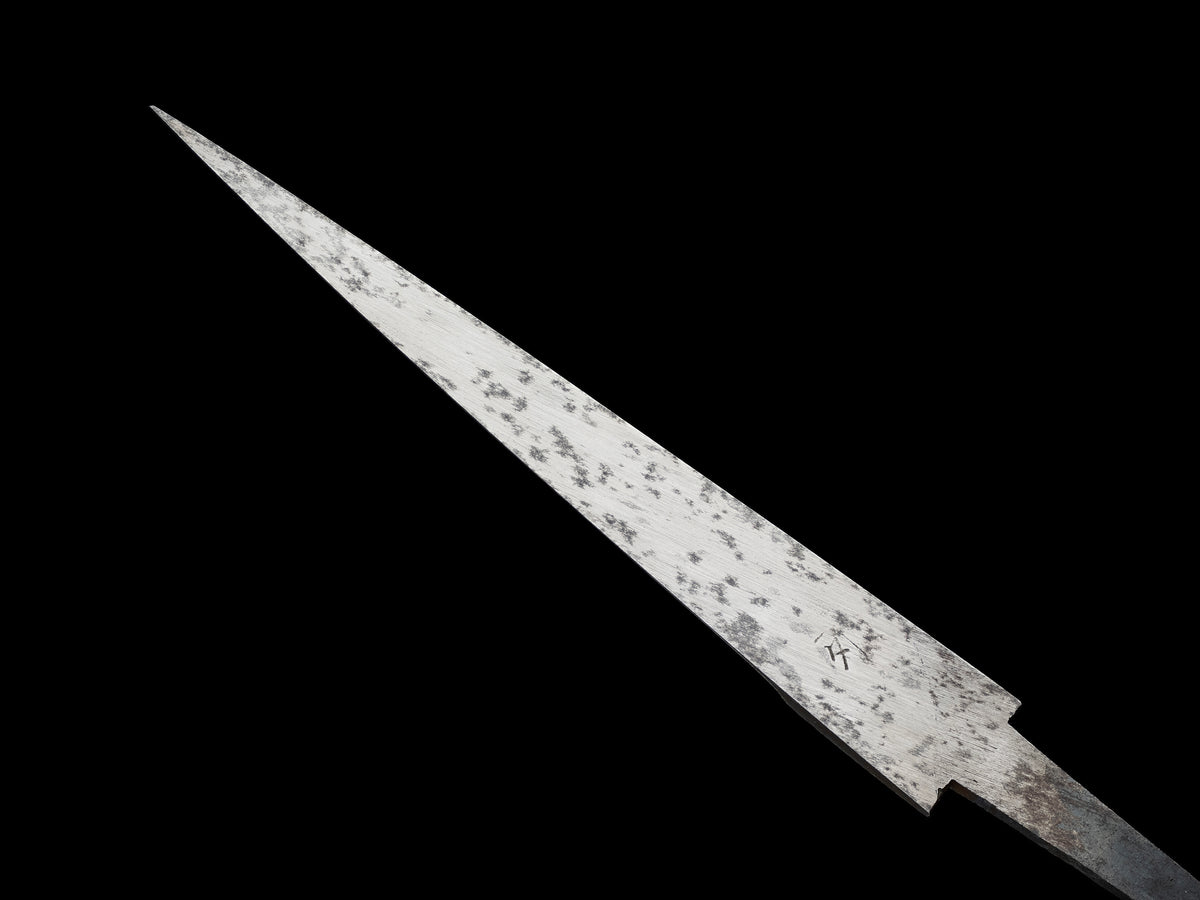
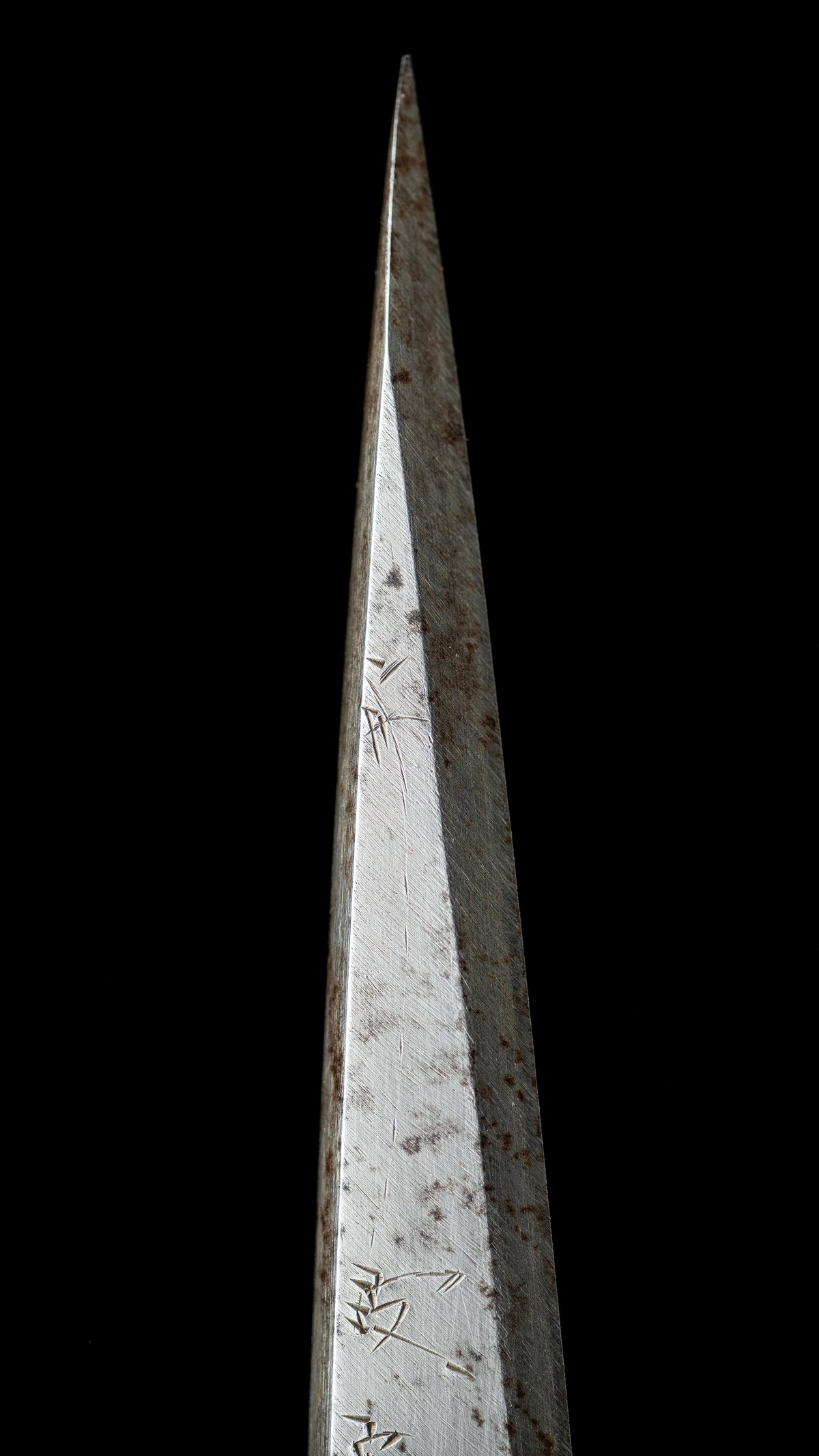
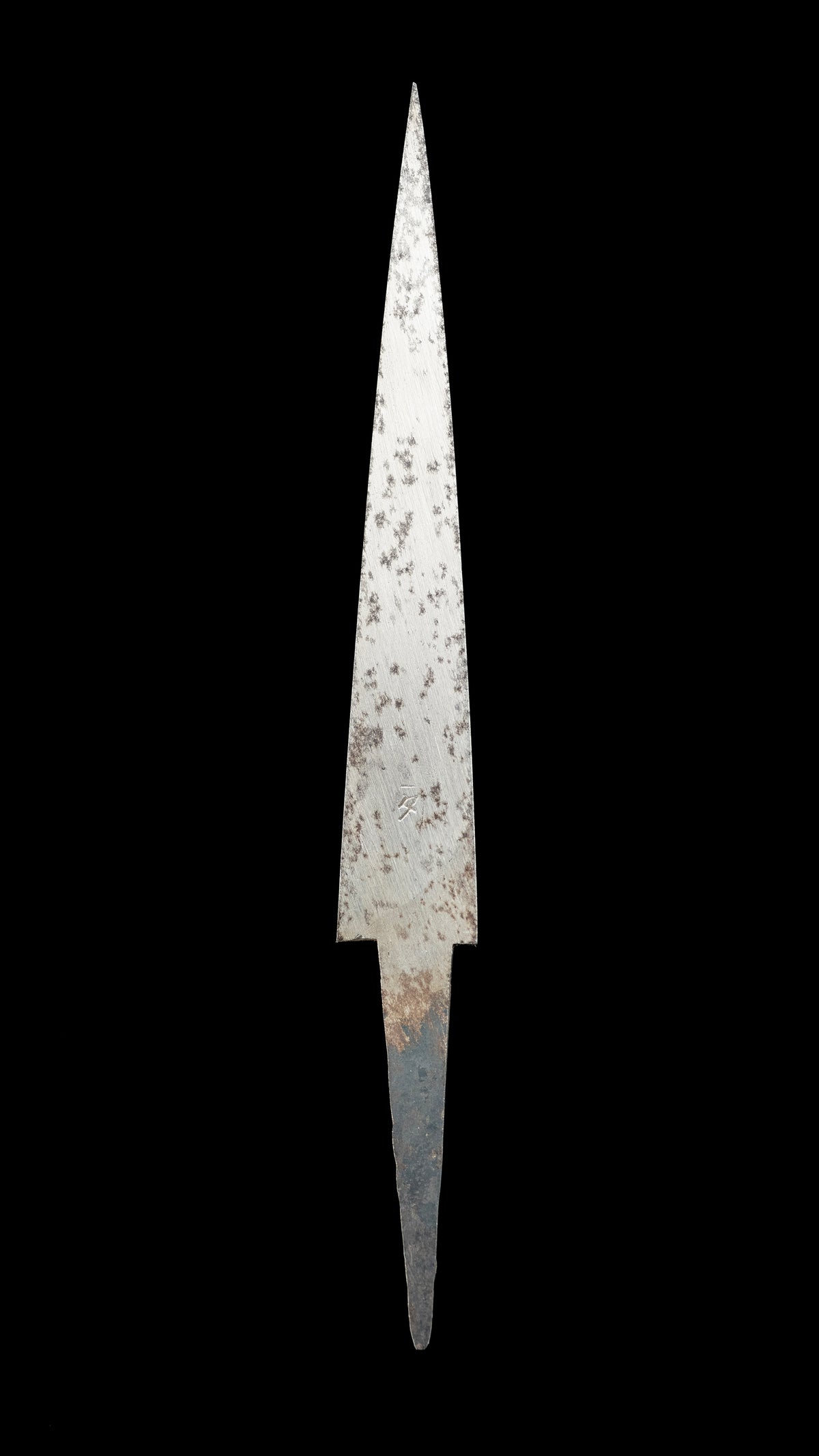
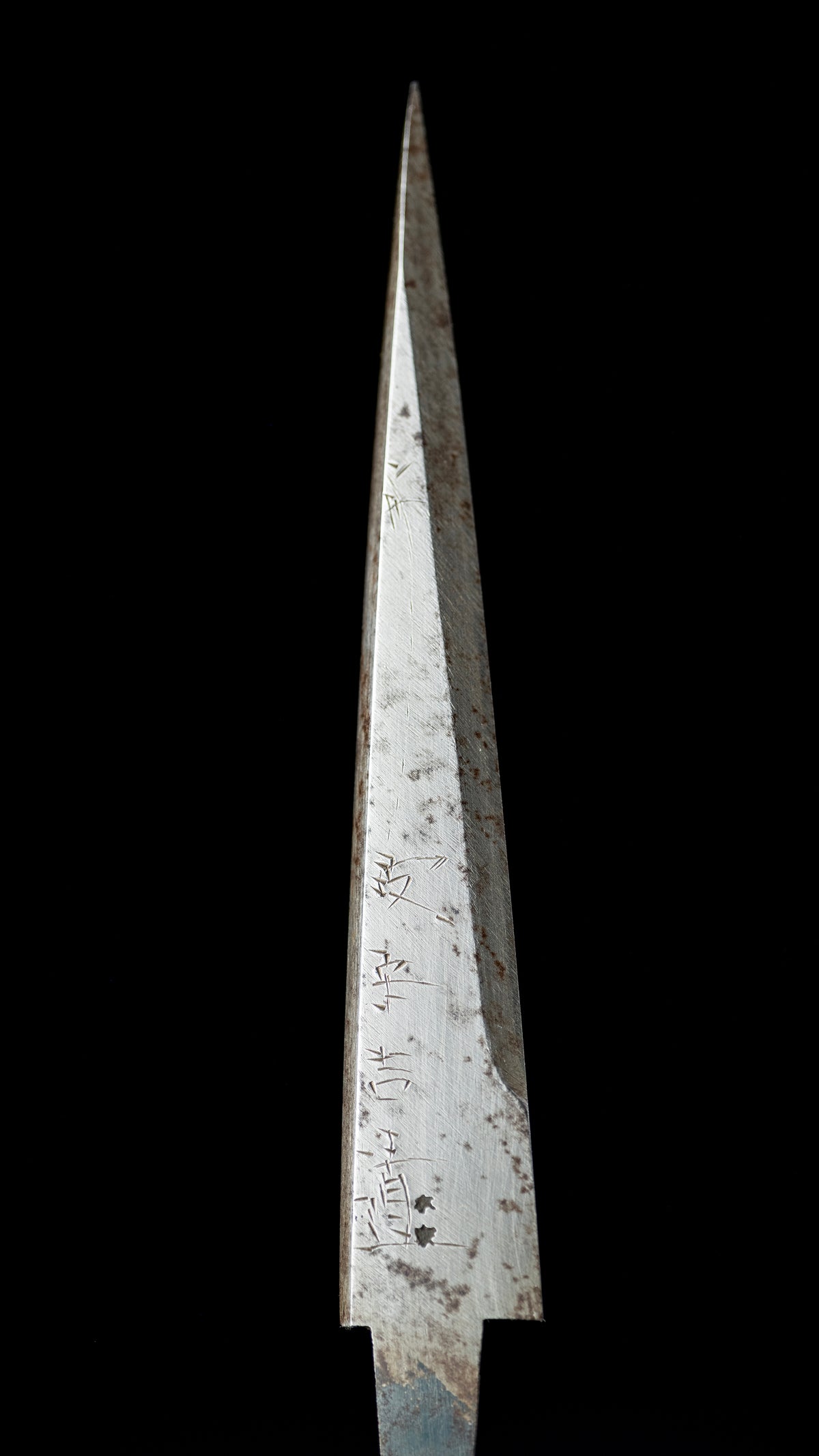
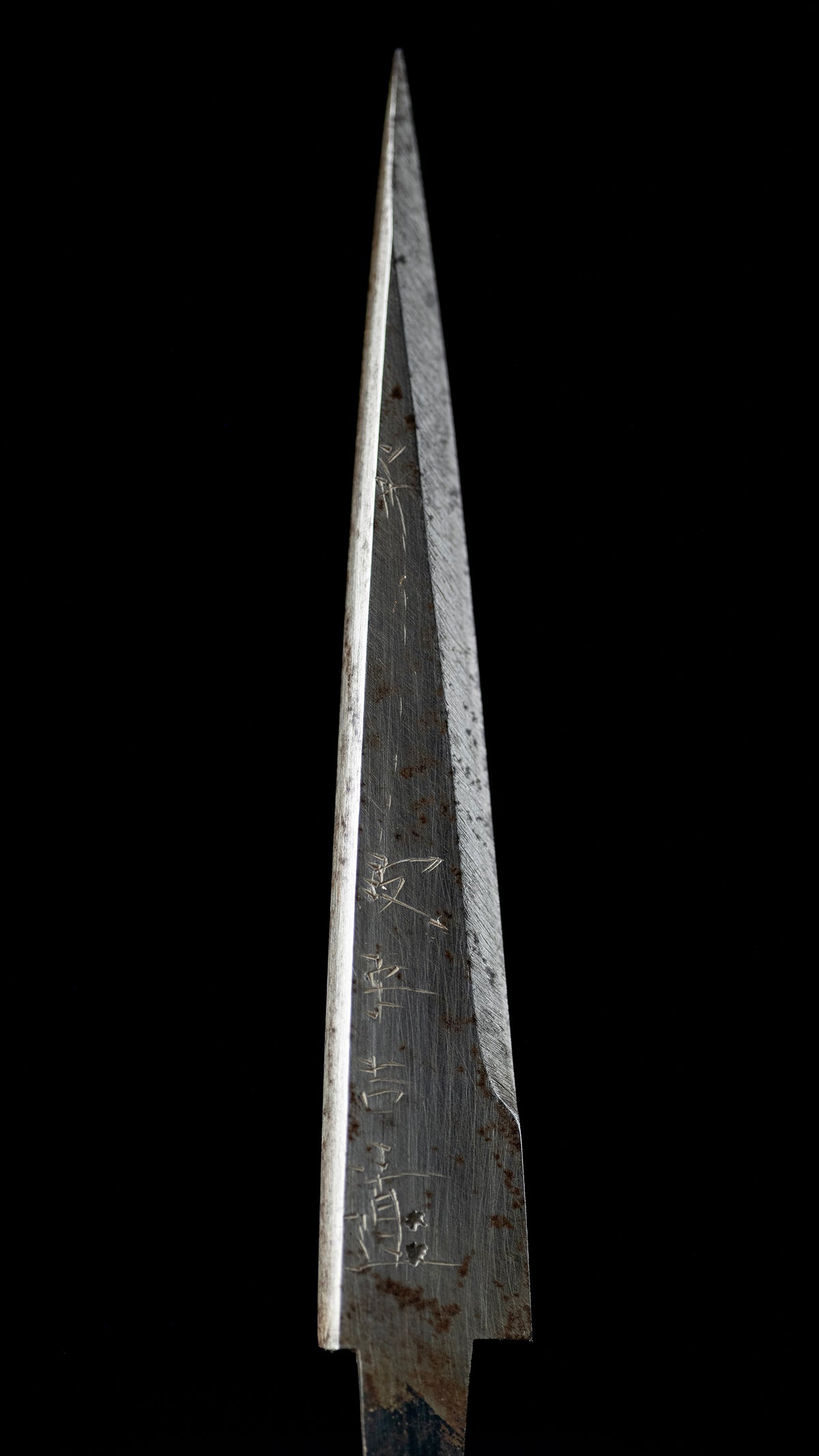
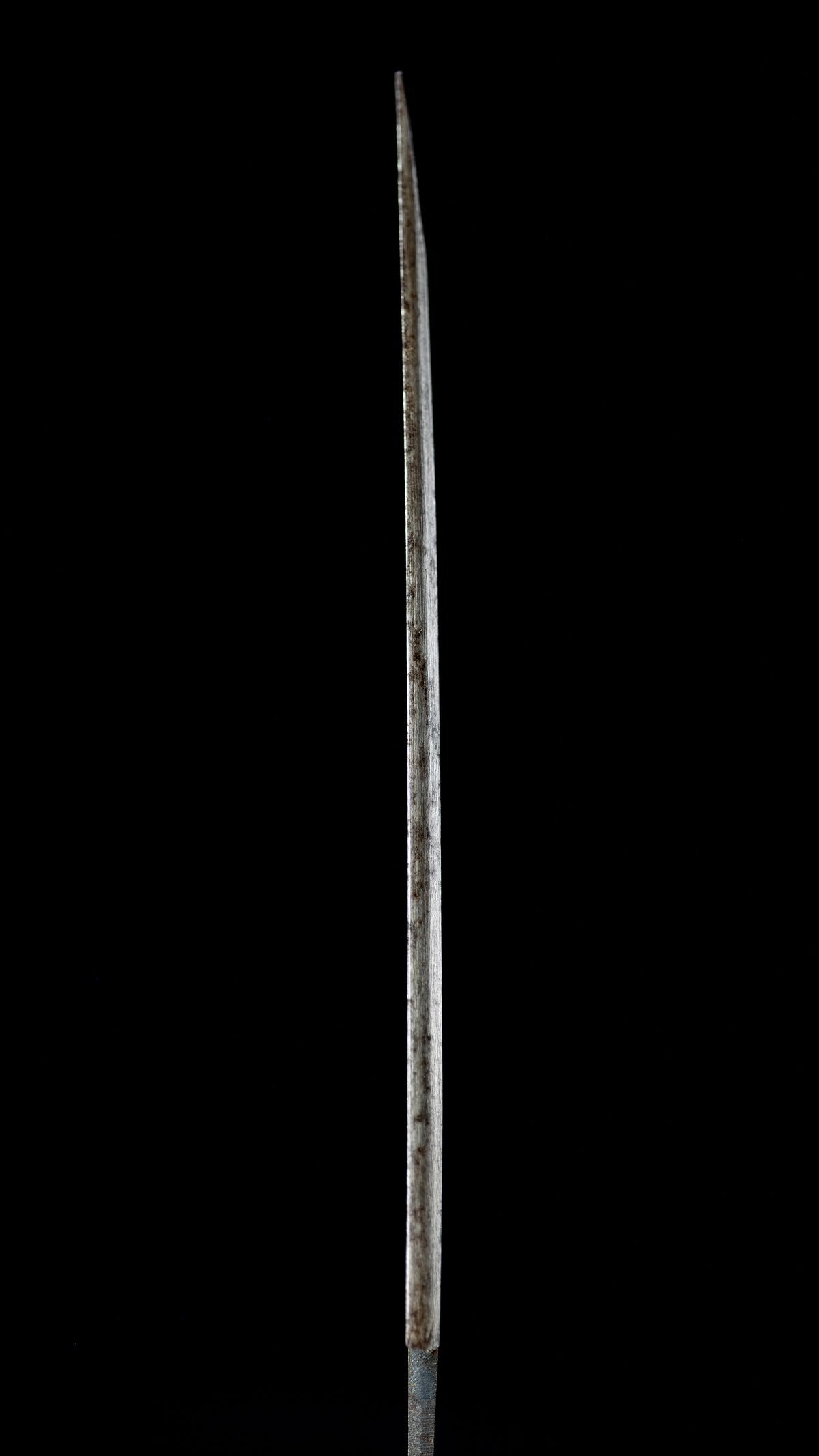
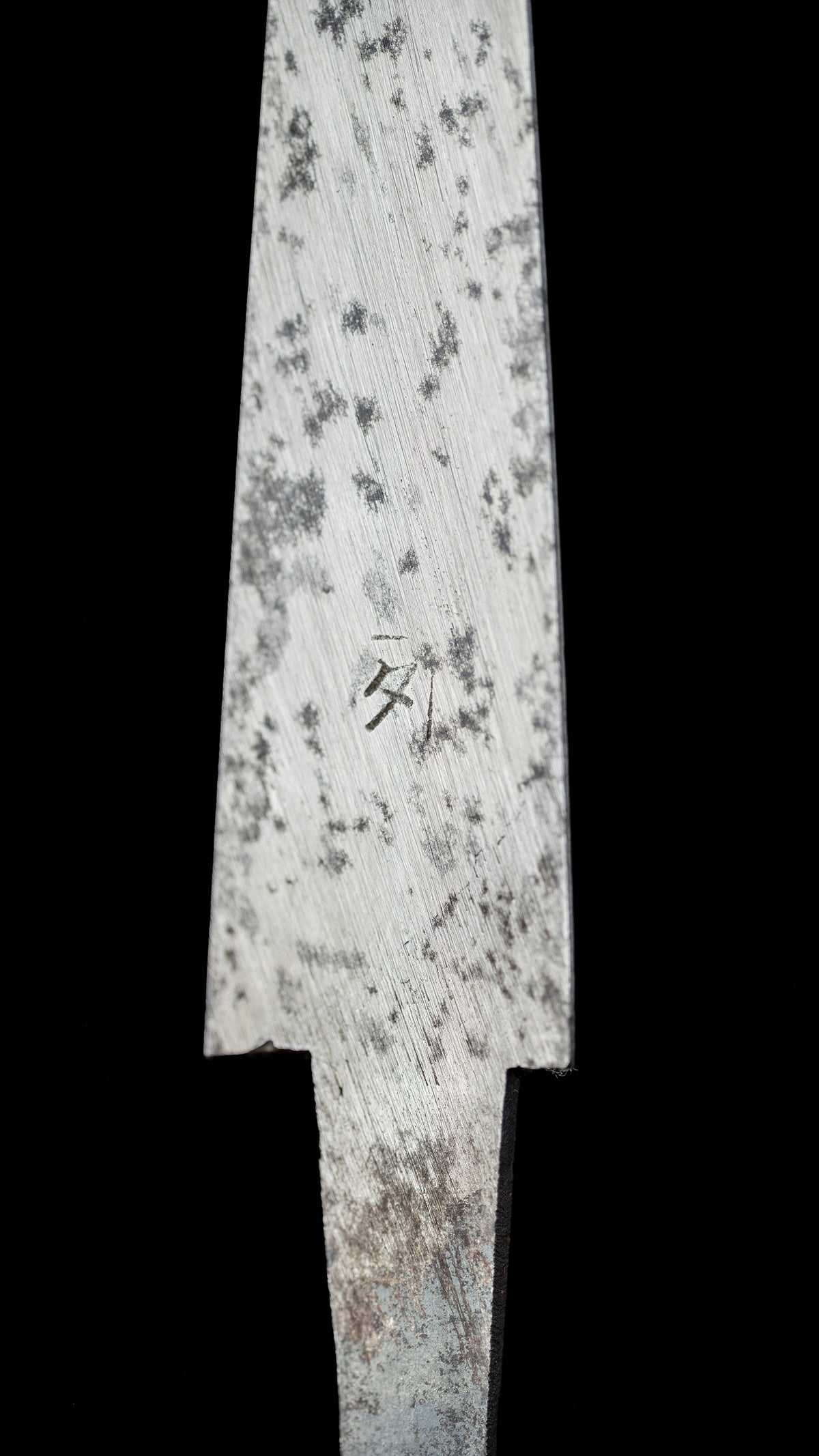
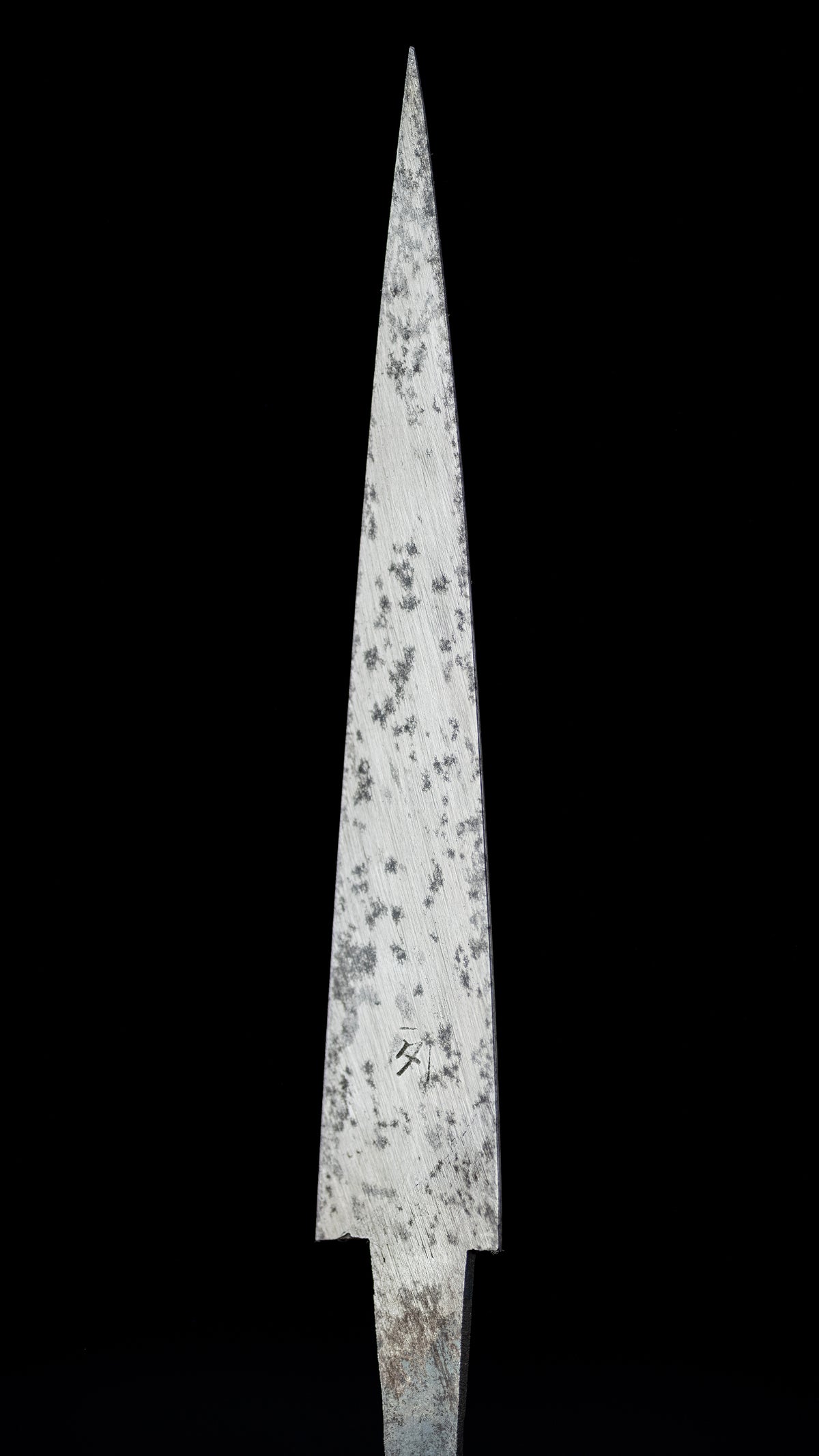
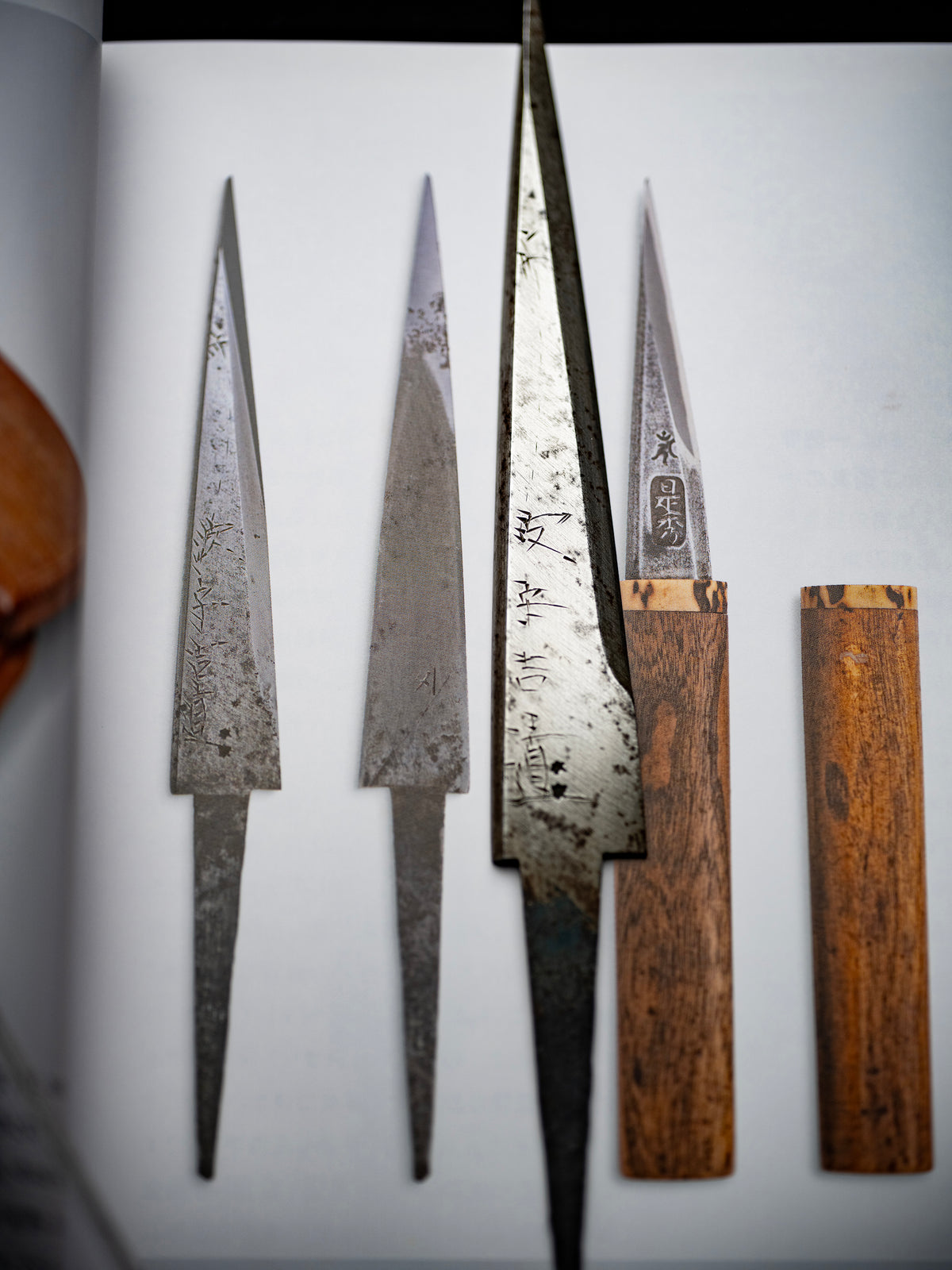
Kuriko-katana Knife By Tanbanokamiyoshimichi For Right Hand - 110mm
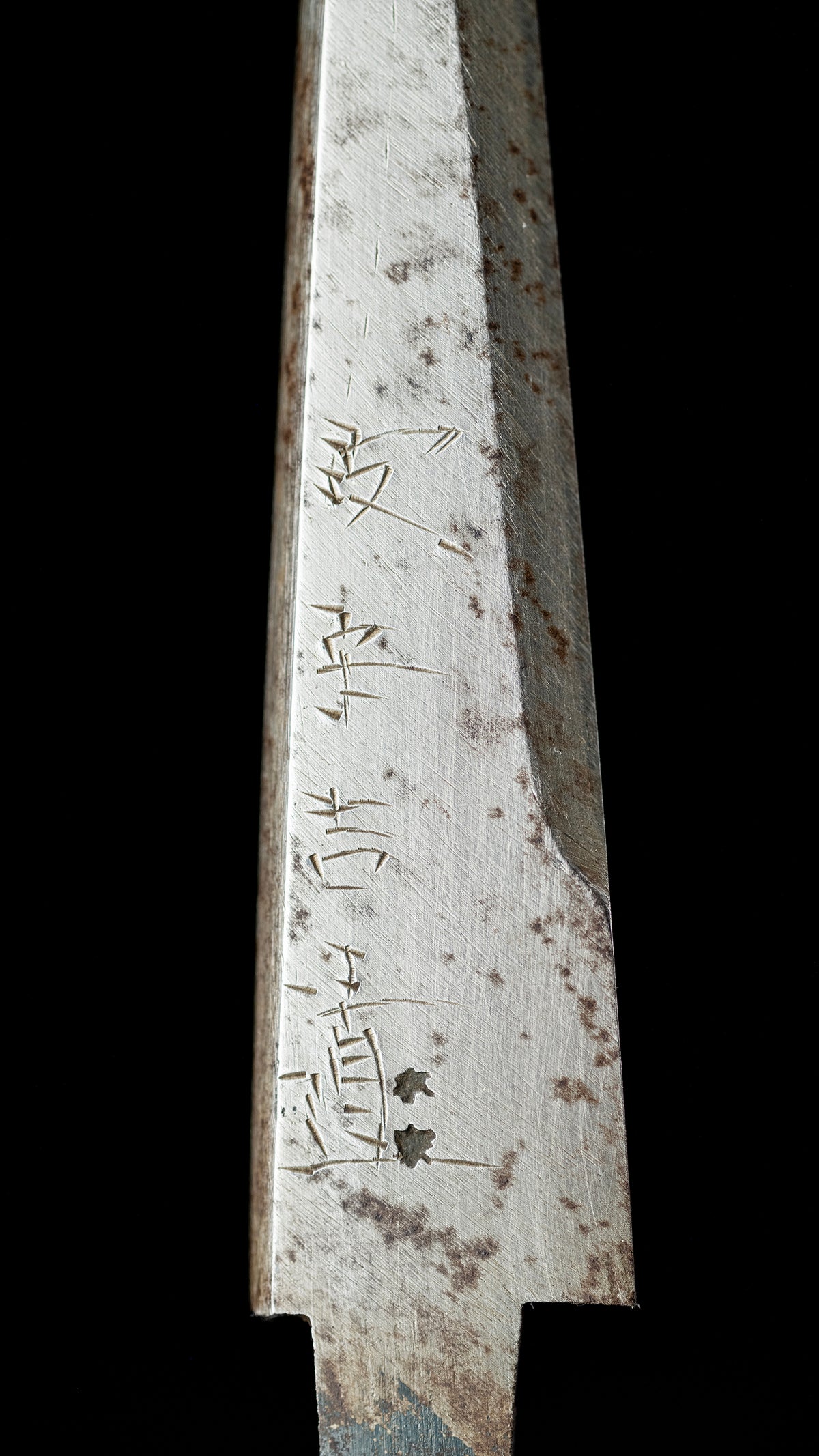
Smith name: Tanbanokamiyoshimichi(丹波守吉道)
Steel: Tamahagane
Effective Blade Length (Theoretical): 130mm
Effective Blade Length (under current sharpening setup): 110mm
Total length: 192mm
Blade width(widest point): about 21mm
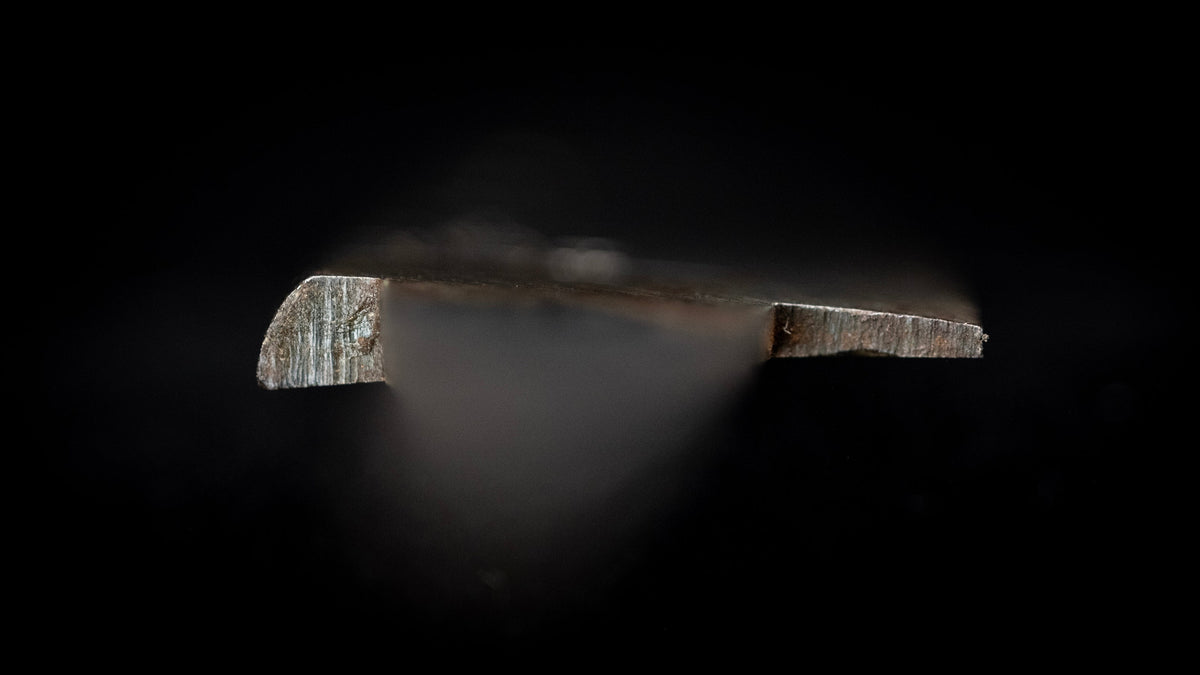
Blade spine thickness: about 2.0~3.5mm
Thickness near the cutting edge: about 2.0mm
Manufacture Era: Edo period to Meiji period (Based on information provided by Mr. Tsuchida Noboru / 土田昇)
Weight: 37g
Blade Angles: about 30°
Additional Information: It is unused, sourced from an edge tool collector in Tokyo. There are some residual rust stains on the blade surface, but fortunately, no deep corrosion or pitting from severe rust. For a kurikogatana (刳小刀) with over a century of history, this is truly a rare find.
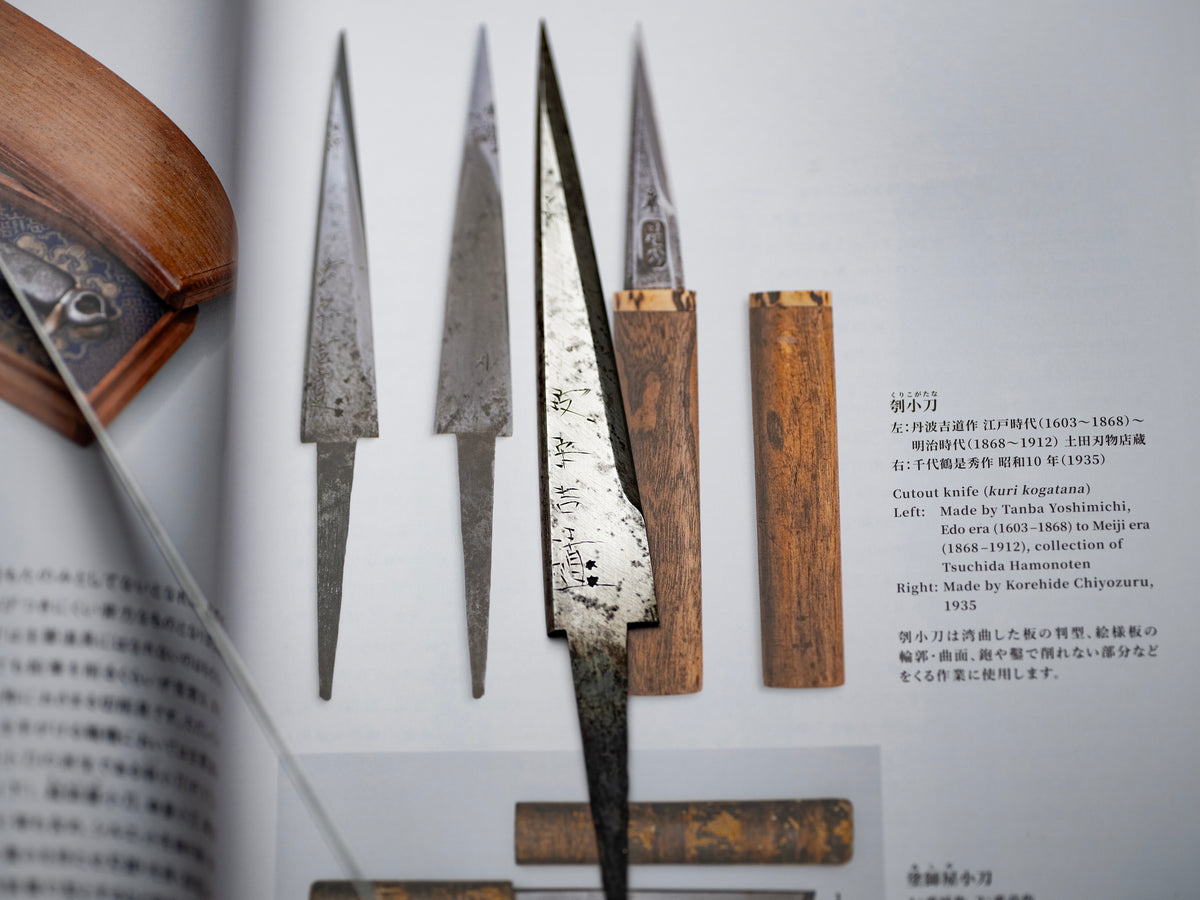
An identical specimen in slightly lesser condition is in the collection of Tsuchida Hamonoten. It was exhibited alongside a kurikogatana by Chiyozuru Korehide on page 11 of the Takenaka Carpentry Tools Museum exhibition catalog, "Kiridashi-Kogatana — Unique Artifacts of Carpenter Tools Blacksmiths," presented together as classic practical knives, as shown in the last two photos.
Even though the knife in the literature appears virtually identical to this piece, I still brought it to Mr. Tsuchida Noboru (土田昇) for his verification. After careful inspection, Mr. Tsuchida confirmed that it was forged by the very same blacksmith who made the piece in his shop's collection.
Mr. Tsuchida (土田昇) told me that this blacksmith was a highly skilled swordsmith from the Kyoto region, whose family's sword-forging lineage spanned from the Edo period into the Meiji period. Additionally, he noted the distinctive layout of the engraved signature (mei / 銘): the first character, "Tan" (丹), is placed near the tip of the blade, positioned unusually far apart from the remaining characters, "ba no Kami Yoshimichi" (波守吉道).
Regarding the history of this swordsmith, I found some helpful supplementary information. I have translated the Japanese text into English and included it below for reference:
“Tamba no Kami Yoshimichi (丹波守吉道) is a lineage name of swordsmiths that originated in Kyoto near the end of the Azuchi-Momoyama period, later branching out to Osaka, and continuing through the late Edo period. He was the third son of Mishina Kanemichi (三品兼道), who moved to Kyoto from Seki in Mino Province (美濃国関). In the 4th year of Bunroku (文禄4年 / 1595), he was granted the honorific title of Tamba no Kami (丹波守).
What made this name especially famous is the sudare-ba (簾刃) temper line. It is a unique hamon (刃文) characterized by multiple lines running parallel along the cutting edge, so named because it resembles hanging bamboo blinds (sudare). It is said to have been developed by the first-generation Yoshimichi and subsequently became the signature hamon of the Mishina school.
Because this was a hereditary title (myōseki / 名跡), swords signed "Tamba no Kami Yoshimichi" are not the work of a single smith. There were successive generations in Kyoto as well as branches in Osaka, and museum and database records often encompass attributions (kiwame / 極め) ranging from the first to the seventh generations. How the sudare-ba presents itself varies by generation, making it both a defining highlight and a challenging point of appraisal. Chronological records show:
Kyoto 1st Generation (京初代): Active from the Bunroku to Kanei eras (文禄〜寛永).
Kyoto 2nd Generation (京二代): Received the title in the 16th year of Kanei (寛永16年 / 1639).
Kyoto 3rd Generation (京三代): Active during the Kambun era (寛文, 1661~1673).
Kyoto 4th Generation (京四代): Active during the Empo era (延宝, 1673~1681).
Kyoto 5th Generation (京五代): Received the title in the 1st year of Shotoku (正徳元年 / 1711).
Kyoto 7th Generation (京七代): Dated inscriptions recorded in the 4th year of Kansei (寛政4年 / 1792).
Osaka 1st Generation (大坂初代): Received the title during the Shoho era (正保, 1644~1648).”
Choose options