
1:
Mark of Nakaya Sukezaemon (中屋助左衛門).
The blacksmith’s surname is Iizuka (飯塚), but his given name remains unknown. Based on existing data, it is highly probable that the maker's mark shown above belongs to either the second or third generation blacksmith. Nakaya Sukezaemon (中屋助左衛門) was one of the most renowned saw blacksmiths in the Aizu region. Along with Nakaya Heijiro (中屋平治郎) of Edo and Miyano Heijiro I (初代宮野平次郎) of the Miki region, he was hailed as one of the "Three Master Saw Blacksmiths" of his era.
The brand endured for five generations, with the smithy located in Nanukamachi, Wakamatsu, Aizu District, Iwashiro Province, Fukushima Prefecture (福島県岩代国会津郡若松七日町). The fourth generation—the last of the original family line—was born in 1880. According to Ichiro Tsuchida's writings, Nakaya Sukezaemon may have been a pioneer in using oil to harden saw blades. However, two alternative theories exist:
1:The book "The Saw Blacksmiths of Aizu: Modern Portraits and Their Genealogies" (『会津の鋸鍛冶 近世の肖像とその系譜』) credits Nakaya Juzaemon VIII (第八代中屋重左衛門) as the pioneer.
2:he book "History of Industrial Culture - Japanese Hand Saws" (『産業文化の歴史 日本の職人・手仕事 鋸』) by Kazuo Hirasawa credits Nakaya Juzaemon VII (第七代中屋重左衛門) as the pioneer.
※ Based on the materials in my possession and online information, it is speculated that Nakaya Sukezaemon I was a disciple of Nakaya Juzaemon VI, and the Nakaya Sukezaemon smithy opened in 1836. The two families were related, and they could be considered part of the same technological collective.
※ The fifth-generation Nakaya Sukezaemon was originally named Shiono Kichizo (塩野吉蔵), born in Sendai (仙台) during the 20th year of the Meiji period (1887). Although highly skilled, he was not a disciple of Nakaya Sukezaemon IV (第四代中屋助左衛門). At the time, the head of the Aizu Sawmakers Guild was reluctant to see the prestigious Nakaya Sukezaemon brand fade into obscurity. He approached the daughter of Nakaya Sukezaemon IV, with her consent, purchased the rights to the brand name for 5 yen. He then bestowed it upon Shiono Kichizo to carry on the Nakaya Sukezaemon lineage.
※ Tips for the Chinese character nakaya (中屋) in the mark. Nakaya Sukezaemon and Nakaya Juzaemon blacksmiths usually use (中や) on carpenters' saws and (中屋) on lumber saws.

2:
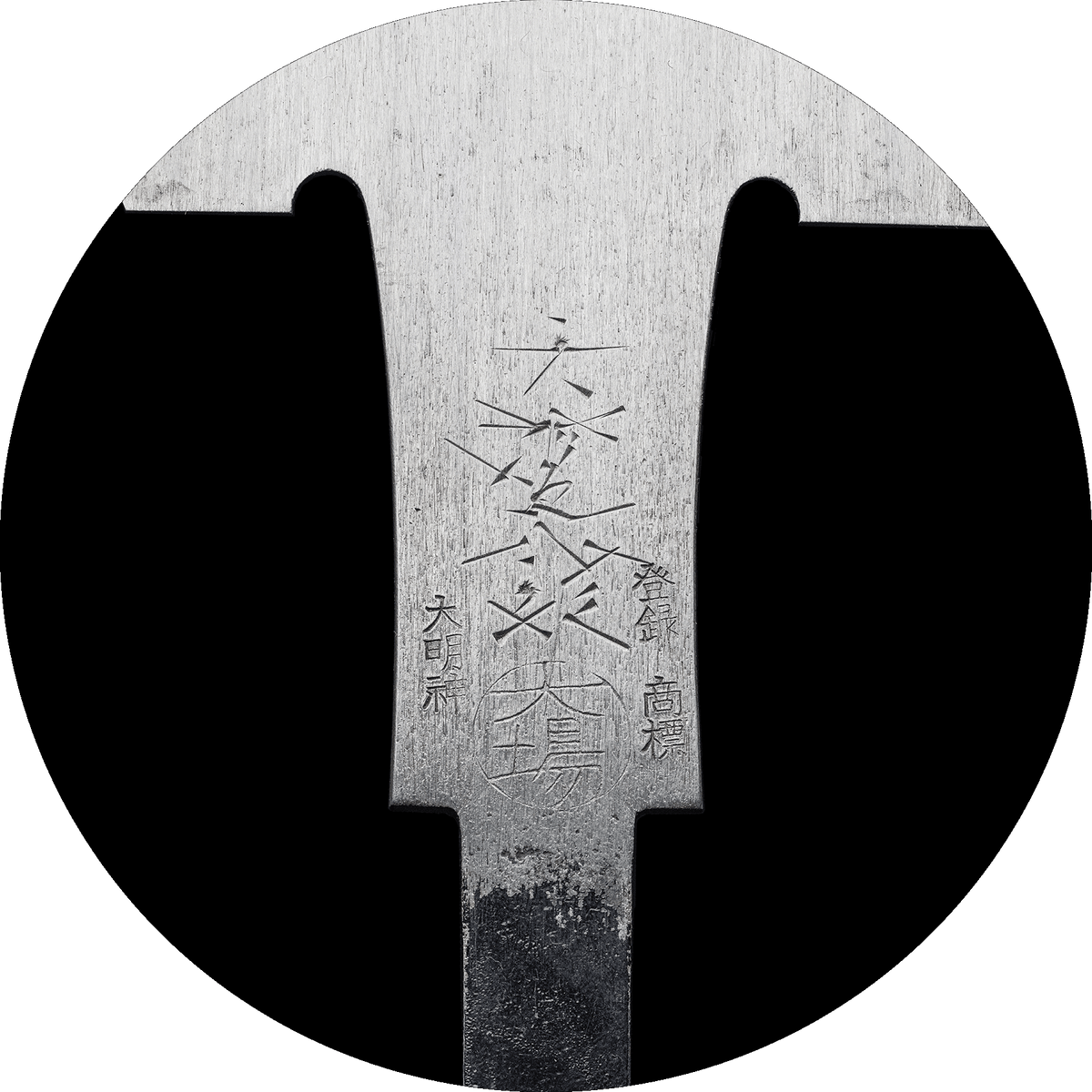
Mark of Nakaya Jube (中屋重兵衛).
Since the hand-engraved maker's mark on this saw is flanked above by two smaller stamps reading “Registered” (登録) and “Trademark” (商標), it indicates that the saw was manufactured after the enactment of the Trademark Registration Act (商標条例) in the 18th year of the Meiji period (1885). Based on this, it is highly probable that the mark belongs to either the fourth or the final generation blacksmith.
Nakaya Jubei I (初代中屋重兵衛) was born in the late 18th century. Legend has it that he had some connection with Nakaya Juzaemon (中屋重左衛門), though the exact details remain unknown. The second generation, born in 1827, was the son of the first generation.
The third generation, whose birth name was Inoue Juzaku (井上重作), was the eldest son of the second-generation blacksmith. Born in 1849, he passed away on February 25 in the 33rd year of the Meiji period (1900). He made outstanding contributions to the development of the Nakaya Jubei (中屋重兵衛) smithy, such as expanding the workshop, training disciples, marrying his eldest daughter to an exceptionally skilled disciple to expand their influence and sales channels, and building a broad network of acquaintances among famous saw blacksmiths throughout Japan.
The fourth generation was named Inoue Hisakichi (井上久吉), born in the 9th year of the Meiji period (17th year of the Meiji period / 1876), and passed away on December 30 in the 9th year of the Showa period (1934). After mastering the family's signature logging saw manufacturing techniques alongside his father, he apprenticed under Nakaya Shigezaemon IX (第九代中屋重左衛門) to study the forging techniques for carpenter's saws. Together with his father, he expanded the smithy and broadened their market footprint. At its peak, the Nakaya Jubei (中屋重兵衛) smithy operated three forging workshops and employed around 15 disciples and workers. In the 38th year of the Meiji period (1905), he began using imported steel bars instead of traditional Tamahagane (玉鋼) to produce saws. Furthermore, he held high prestige locally and maintained deep connections with many master craftsmen in the Aizu (会津) region, such as Shigefusa (重房), Shigemichi (重道), and Shigemasa (重正). He was also hailed as one of the "Four Heavenly Kings of Saw Forging" during Japan's Taisho period, alongside Nakaya Kumagoro (中屋熊五郎) of Kiryu (桐生), Nakaya Inosuke (中屋伊之助) of Sanjo (三条), and Nakaya Magoemon (中屋孫右衛門) of Hyuga (日向).
The fifth generation was the eldest son of the fourth generation, born on March 19 in the 42nd year of the Meiji period (1909), and passed away on August 15 in the 60th year of the Showa period (1985). For reasons unknown, he shared the exact same name as his father (Inoue Hisakichi / 井上久吉). The logging saws he crafted won first prize at the National Saw Competitive Exhibition held in Tokyo during World War II. In the 37th year of the Showa period (1962), harboring doubts about the future prospects of the saw-making industry, he closed down the smithy and joined a major building materials corporation, becoming one of its distributors.

3:
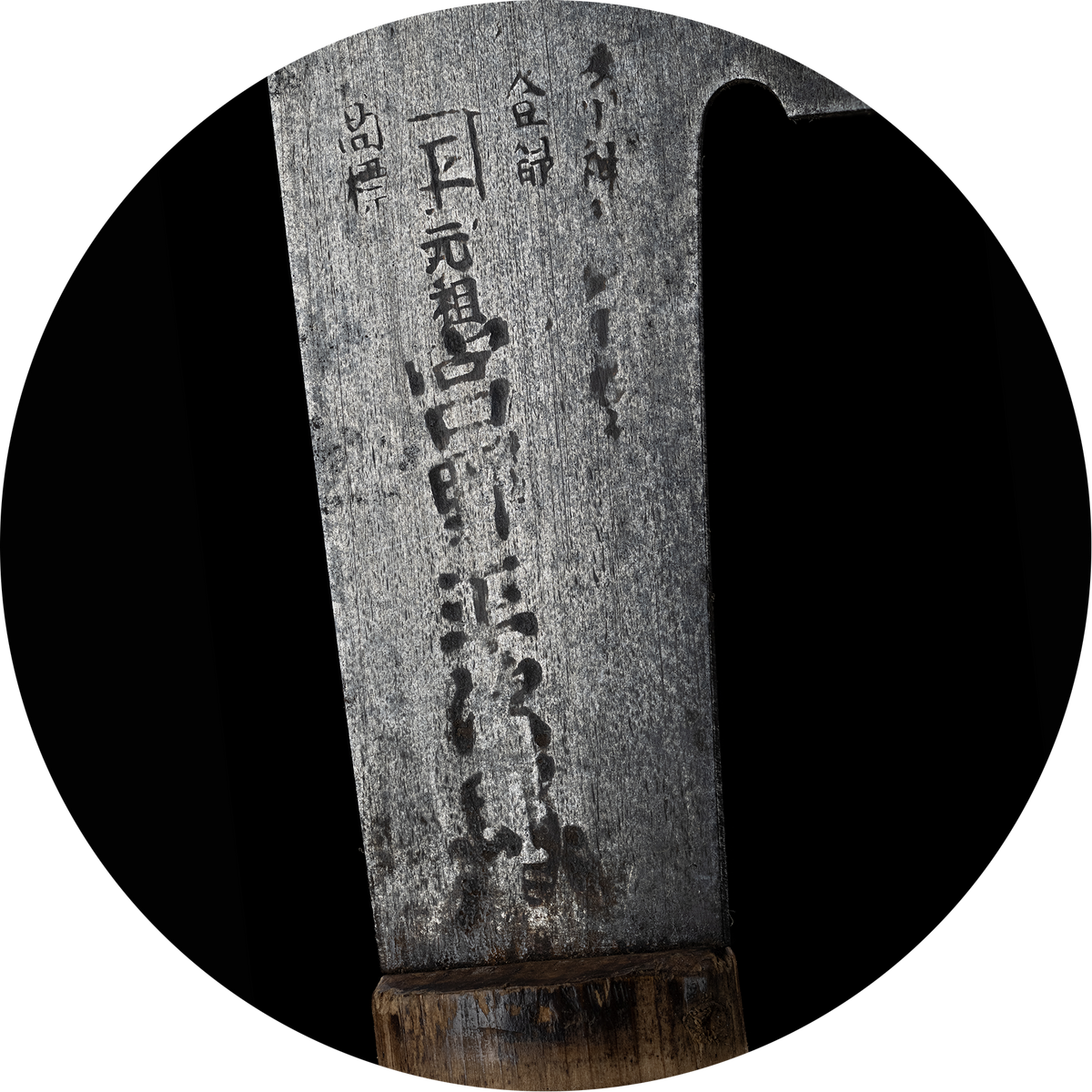
Mark of Nakaya Seiemon Ⅰ(初代中屋清右衛門).
The stamp 'Hoken/保険' (Guarantee) appears above the blacksmith's mark (read right-to-left). This specific mark was gradually phased out in favor of 'Toroku/登録' (Registered) after the trademark laws were enacted in Meiji 18 (1885).
The smithy spanned two generations. Born in Meiji 10 (1877), the first generation master's real name was Watanabe Seizo( 渡部清蔵) . He came from a family of tofu makers (his father and grandfather). He was the very first apprentice of the Nakaya Jukichi I(中屋重吉). After completing his training, he worked independently for ten years, becoming known for his high level of technical skill. Later, he joined a local company, the Ohira Saw Factory. When the factory closed during the Taisho era, Seizo—then over 40 years old—was hired by the local Sato Kiyoshi Shoten (Store) to continue his work. The saws he produced there were widely acclaimed. He passed away on January 22, Showa 22 (1947).

.%0A%0AThe%20blacksmith%E2%80%99s%20surname%20is%20Iizuka%20(%E9%A3%AF%E5%A1%9A),%20but%20his%20given%20name%20remains%20unknown.%20Based%20on%20existing%20data,%20it%20is%20highly%20probable%20that%20the%20maker's%20mark%20shown%20above%20...)