
『Sawsmith Marks of the Niigata Region』
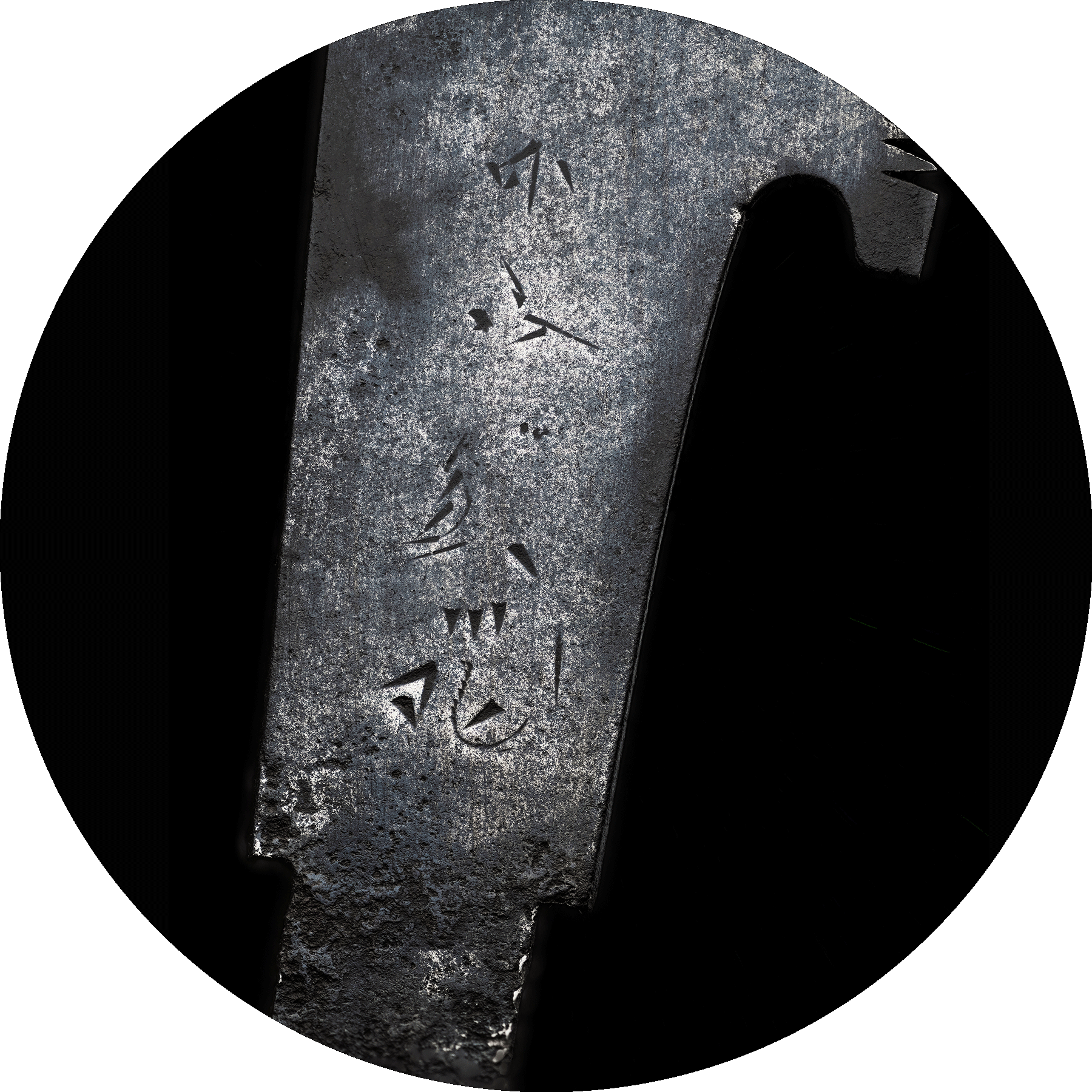
 1: Mark of Nakaya Inosuke Ⅲ (三代中屋伊之助): The blacksmith's real name was Fukazawa Inosuke (深沢伊之助, 1820–1889). They are a prestigious family of saw-smiths based in Sanjo City, Niigata Prefecture. The ancestors were originally no-kaji (Rural Blacksmiths) who forged agricultural tools and everyday utensils. The first generation was born in 1758 and passed away in 1822; the second generation was born in 1798 and passed away in 1853. According to historical records, the second-generation Inosuke apprenticed under Abe Shiheimon (阿部四兵衛門) to learn saw-making, subsequently establishing the saw blacksmith shop in 1817. (Alternatively, an post from Mr. Tsuchida Noboru's X posts suggests that the family actually began making saws from the third generation).
Mr. Tsuchida told me that because Inosuke's ancestors excelled at making thin kitchen knives (such as nakiri knives), they had accumulated a profound foundation in forging thin blades, which allowed them to smoothly transition into becoming saw-smiths. It is no exaggeration to say that the vast majority of saw-smiths in Sanjo City trace their lineage back to the Inosuke line. The reverse side of this saw's tang (neck) is stamped with the "Hon-I" (本伊) mark, I will add a photo of it later.
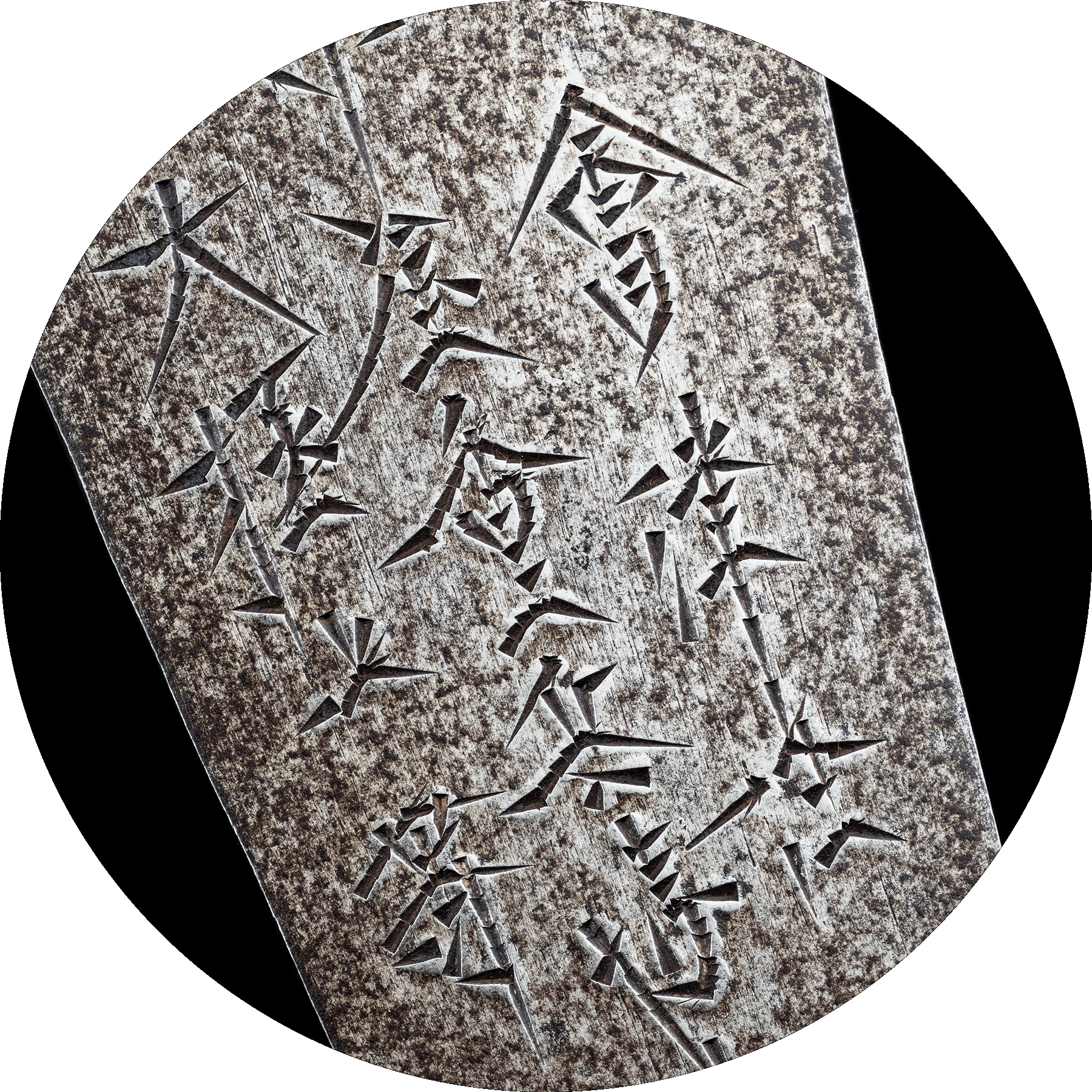
 2: Mark of Nakamoto Sadatsugu (中元定次). The blacksmith's real name was Fukasawa Sadatsugu (深沢定次). This saw was appraised by Mr. Tsuchida Noboru as a piece from the Taisho era. Based on the historical data I have gathered, it is likely the work of either the second-generation Nakamoto Sadatsugu (birth and death years unknown) or the first-generation Nakamoto Sadatsugu (born in 1848, death year unknown). This brand represents a major, direct branch of the prominent Inosuke (伊之助) lineage. The first-generation Fukasawa Sadatsugu was the second son of Nakaya Inosuke III (三代 中屋伊之助). Due to the traditional system of primogeniture (where the eldest son inherits the family headship), he could not succeed to his father’s title and name. Consequently, he established his own independent saw-smith forge in 1877—naming his brand "Nakamoto Sadatsugu (中元定次)." The workshop operated successfully through four generations before eventually closing its doors.
 3: Mark of Nakaya Inosuke VII (7代中屋伊之助). The blacksmith's real name was Inosuke Fukasawa (深沢伊之助, 1953–?). This is currently the most common "Nakaya Inosuke" mark found on the market. The reverse side bears the "Hon-I" (本伊) mark. Regarding this "Hon-I" mark, I would like to share some insights from Mr. Noboru Tsuchida's X posts:
"It was during the early Showa 10s (the period between 1935 and 1944) that my father (Tsuchida Ichiro / 土田一郎) began direct business transactions with Inosuke. At that time, my father purchased the most expensive Inosuke saw at a government-affiliated trade exhibition held in Tokyo, and brought it with him to Sanjo. If I remember correctly, that particular saw did not have the 'Hon-I' mark on it.
Furthermore, we have a saw in our collection that was registered in Manchukuo. At the time, official price controls (wartime price regulations) were implemented in Japan, making it impossible for high-end, premium goods to circulate domestically. Therefore, this saw was registered in Manchukuo specifically to circumvent domestic Japanese laws..."
"The saws gained massive fame due to their exceptional performance → Counterfeits and low-quality knockoffs began to appear → The 'Hon-I' mark was introduced to verify authenticity → Even the 'Hon-I' mark was counterfeited → The brand registered a trademark → Counterfeiters still produced knockoffs relentlessly → Registration numbers were eventually stamped directly onto the tang (the part of the blade that goes into the handle), which also marked the period when the 'Hon-I' mark was discontinued → Yet, the counterfeiters untiringly continued their bootlegging...
On the post-WWII Showa era, a certain wholesaler in Sanjo once confessed: 'When I first started out as an apprentice at the wholesaler, my foundational training was learning how to engrave fake Inosuke mark. And I was actually quite good at it.'"
[My Annotation]:
"Manchukuo" here refers to the puppet regime established by Japan in Northeast China during its wartime occupation.
 4: Mark of Nakaya Sadagoro I (初代中屋貞五郎). The blacksmith's real name was Shibuki Sadagoro (渋木貞五郎, 1896–?). He was one of the most renowned of the ten disciples who trained under Nakaya Inosuke V. Likely because his exceptional skills were highly recognized by his master, he was granted the rare privilege of inheriting the master's prestigious "Nakaya (中屋)" brand name. He established his own independent saw-smith forge in 1919 and went on to train numerous disciples—17 in total, including his own son.
 5: Mark of Nakaya Sadagoro II (二代 中屋貞五郎). The blacksmith's real name was Shibuki Sadaichi (渋木貞一, birth and death years unknown). As the eldest son, he succeeded to his father's brand and work shop. Meanwhile, his younger brother, Shibuki Teisuke (渋木貞助), branched out to establish his own independent brand. Despite operating separate businesses, the two brothers' workshops were located right next to each other, and they even shared some of their equipment.
 6: Mark of Shibuki Teisuke (渋木貞助). The blacksmith's real name was Shibuki Teisuke (渋木貞助, birth and death years unknown). He was the younger son of Nakaya Sadagoro I (初代中屋貞五郎). He established his own independent saw-smith forge in 1951, using his actual name directly as the brand mark for his saws. Among the many disciples who trained under Nakaya Inosuke V, the saws crafted by the Nakaya Sadagoro and Shibuki Teisuke were considered the most popular and highly sought after.
 7: Mark of Oba Shoichiro I (初代大場正一郎).The blacksmith's real name was Shoichiro Oba (大場正一郎, born January 10, 1899; death year unknown). Although Shoichiro Oba was recognized as one of the master saw-smiths of the highest caliber in the Sanjo region after World War II, his lineage does not trace back to the Inosuke (伊之助) line. According to the records in my possession, his master was Igarashi Mankichi (五十嵐万吉), who established his business in the 30th year of Meiji (1897). Tracing this lineage back to its roots, Oba actually belongs to the school founded by Higuchi Minezaburo (樋口峰三郎), who established his forge in 1832. While most of the blacksmiths within this particular school remained relatively obscure, the total number of smiths descended from this lineage is nearly equal to that of the prominent Inosuke line.
 8: Mark of Yamakuchi Sukezaemon (山口介左衛門). The blacksmith's real name was Yamaguchi Shunsuke (山口俊介, 1911–1975). In his early years, he used the maker's mark "Nakaya Sukezaemon"(中屋介左衛門) . Later, due to the appearance of counterfeits, he switched to using "Yamaguchi Sukezaemon" and began stamping the reverse side with the "Hon-Suke" (本介) mark. Mr. Tsuchida Noboru once shared a few interesting anecdotes regarding Yamaguchi Sukezaemon with me:
While the specific batches varied, it is certain that he exclusively used carbon steel, never alloy steels like Blue steel (Aogami).
The master hammer smith Kozaburo often encountered Yamaguchi at steel shops in Sanjo, testifying to his rigorous selection process.
Naturally, despite this extreme hardness, the steel retains excellent toughness (tenacity) to prevent the blade from snapping—a balance similar to that of Kiyotada chisels, which are also renowned for their exceptional edge retention.
However, this hardness made the manual scraping process using the "Sen" tool incredibly labor-intensive. The hard steel created significant cutting resistance and caused the tool to slip easily, requiring immense skill and time to finish.
:%20The%20blacksmith's%20real%20name%20was%20Fukazawa%20Inosuke%20(%E6%B7%B1%E6%B2%A2%E4%BC%8A%E4%B9%8B%E5%8A%A9,%201820%E2%80%931889).%20They%20are%20a%20prestigious%20family%20of%20saw-smiths%20based%20in%20Sanjo%20City,%20Niigata%20Prefecture.%20The%20...)